What Is Human-in-the-Loop AI? (And How to Tell If an Agent Actually Has It)
Human-in-the-loop AI keeps a person in control of what an agent does. Here's what the term actually means, the difference between in-the-loop, on-the-loop, and out-of-the-loop, and how to tell good design from safety theater.
TL;DR: Human-in-the-loop (HITL) AI means a person stays in control of the decisions an AI system makes, approving or correcting its actions before they take effect. For AI agents that can act on your behalf, it’s the main thing standing between “helpful” and “dangerous.” But the label is easy to claim and hard to earn: an agent that technically asks for approval can still leave you with no real control. Here’s what the term means, the three postures you’ll hear about, and how to tell a genuine safeguard from a checkbox.
“Human in the loop” is one of those phrases that shows up in every AI product page and almost never gets defined. It sounds reassuring, so it gets used as a synonym for “safe” and left there. But it’s a specific idea with a real history, and if you’re going to trust an AI agent to act on your behalf, it’s worth knowing what it actually promises, and what it doesn’t.
What human-in-the-loop AI means
Human-in-the-loop AI is any system where a person is part of the decision cycle: the AI proposes, and a human approves, edits, or rejects before the action takes effect. The human is inside the loop, not watching from outside it. Nothing consequential happens without a person having a say.
The term predates the current wave of AI. It comes from control systems and machine learning, where “the loop” is the cycle of sense, decide, act. A human-in-the-loop system routes a person into that cycle at the decision point. In older machine-learning work it usually meant a human labeling data or correcting a model’s output to improve it. In today’s agentic AI it means something more immediate: a human authorizing an action before the agent carries it out in the real world.
That shift matters. When an agent can send a message, reschedule a meeting, move money, or run code, the “act” step isn’t a prediction on a screen anymore. It’s a thing that happens to your accounts, your coworkers, your calendar. Human-in-the-loop is the design choice that says: a person decides whether that thing happens.
In the loop, on the loop, out of the loop
You’ll hear three postures. The distinction comes from decades of debate over autonomous systems, where it was formalized as degrees of human control, and the difference between them is exactly how much control the human keeps.
Human-in-the-loop. The system pauses and waits for a person before acting. The agent drafts the email; you read it and hit send. Control is direct, and the cost is your attention: the system can’t proceed without you. This is the right posture for actions that are consequential or hard to undo.
Human-on-the-loop. The system acts on its own but a person supervises and can intervene, pause, or override. Think of a factory line or a fraud-detection system that runs autonomously while a human watches the dashboard and steps in when something looks wrong. Control is indirect, exercised by exception rather than by approval. It scales to high volume, but it assumes the human is actually watching and can catch a bad action in time.
Human-out-of-the-loop. The system acts fully autonomously with no person in the decision path. Fast, cheap, and appropriate only where mistakes are cheap and reversible, or where speed genuinely rules out a human (high-frequency trading, real-time ad bidding). For anything that touches people or is hard to undo, it’s the posture that gets companies into trouble.
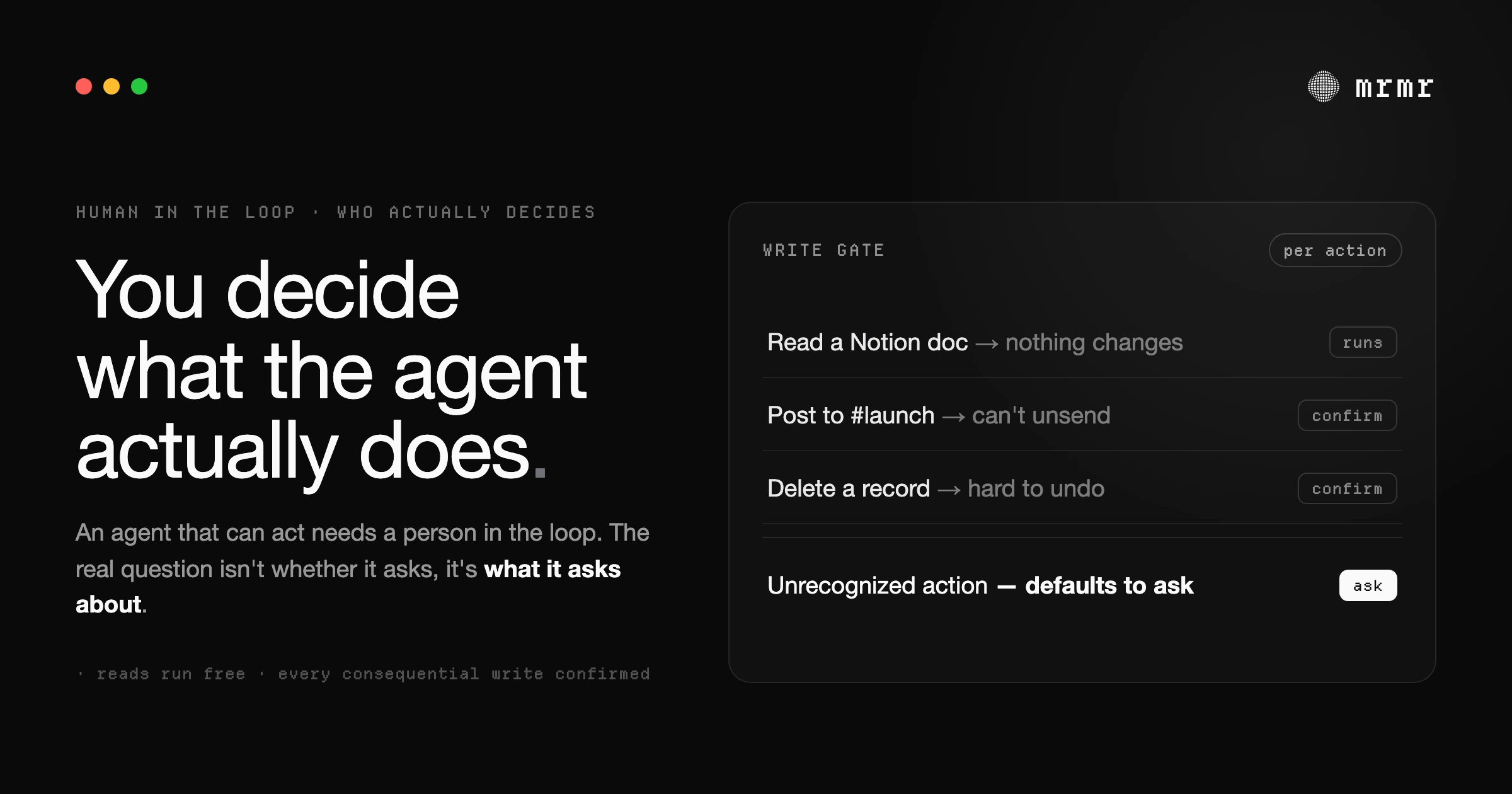
Most good agent design isn’t one of these applied uniformly. It’s a mix, chosen per action. Reading your calendar can be out-of-the-loop, because a read changes nothing. Sending a message to your team should be in-the-loop, because it can’t be unsent. The interesting question is never “does this agent have a human in the loop,” but “for which actions, and does it draw that line well.”
Why agents made this urgent
Chatbots didn’t really need human-in-the-loop safeguards, because their output was just text on a screen. You read it, and you decided what to do with it. The human was naturally in the loop because the AI couldn’t do anything except talk.
Agents broke that. An AI agent doesn’t stop at suggesting; it can take the action itself, across your real tools. That’s the entire point of an agent, and it’s also what makes an ungated one risky. Once the model’s output is wired to a “send” button, every quirk of the model becomes a quirk of your actual accounts. A hallucinated recipient becomes a real misdirected message. A misread instruction becomes a real deleted record.
So human-in-the-loop stopped being an academic nicety and became the load-bearing safety design for consumer and work agents. It’s the answer to the obvious worry: if this thing can act for me, how do I make sure it doesn’t act against me?
The catch: “has a human in the loop” is easy to fake
Here’s where most of the marketing quietly falls apart. It is trivial to add a confirmation step and claim human-in-the-loop. It is much harder to build one that keeps you actually in control. Two failure modes show up constantly.
The first is asking about everything. An agent that confirms every action, including trivial reads and reversible one-taps, floods you with approvals until you stop reading them and start reflexively clicking yes. That’s approval fatigue, and it’s the failure mode that turns a real safeguard into theater. A confirmation you don’t read isn’t control; it’s a ritual. Paradoxically, the agent that asks the most often keeps you the least in the loop.
The second is trusting the model to police itself. The tempting shortcut is to write “confirm consequential actions” into the agent’s instructions and trust it to comply. But large language models are non-deterministic: the same request can behave differently on different runs, even with settings meant to pin them down, and a policy that lives only in the prompt can be talked out of it by a confusing request or a prompt-injection attack hidden in the content the agent is reading. If the only thing standing between the agent and your apps is the agent’s own good intentions, you don’t have a safeguard. You have a suggestion.
Real human-in-the-loop design has to solve both: ask about the right things (not the most things), and enforce the asking somewhere the model can’t overrule.
How human-in-the-loop works in AI agent frameworks
If you build agents rather than buy them, the major frameworks now ship the in-the-loop pattern as a primitive: pause before a sensitive step, hand the decision to a person, resume with their answer.
- OpenAI Agents SDK. A tool can declare
needs_approval, either always or through a function that decides per call. When the model calls that tool, the run pauses and returns the pending approvals; you approve or reject each one and resume the run (OpenAI Agents SDK docs). - LangGraph. Calling
interrupt()inside a node saves the graph’s state and waits. You resume by invoking the graph again with aCommand(resume=...)carrying the person’s input. It needs a checkpointer so the paused state survives (LangGraph docs). - CrewAI. Setting
human_input=Trueon a task makes the agent ask a person for input before it delivers its final answer, which suits reviewing an output more than approving an individual action (CrewAI docs).
The pattern is the same in all three: the approval is a checkpoint in the code path, not a sentence in the prompt. That is the property the next section asks you to check for in any agent you use.
How to tell if an agent actually has it
When a product says “human in the loop,” here are the questions that separate the real thing from the label:
- What does it ask about, and what does it skip? A good agent confirms consequential, hard-to-undo actions and stays out of your way on reads and trivially reversible ones. If it asks about everything, expect approval fatigue. If it asks about almost nothing, expect silent mistakes.
- Where does the confirmation live? Is the gate enforced by the software itself, below the model, or is it just an instruction in the prompt that the model is trusted to follow? Only the former survives a model that misbehaves or gets manipulated.
- What can you see before you approve? A meaningful confirmation shows you the actual details: the exact recipient, the exact content, the exact record being changed. A vague “the agent wants to do something, allow?” isn’t reviewable.
- What happens with something new or ambiguous? A safe default is to ask when the system isn’t sure. If unfamiliar actions run without a prompt, the gate has holes.
How mrmr approaches it
mrmr is a voice-first AI agent for Mac, and human-in-the-loop is the design it’s built around, so it’s a concrete example of these answers.
The gate is deterministic, not a prompt. When the agent goes to take a write action, the app refuses to execute it unless you’ve approved a confirmation card matching that exact action and its exact arguments. Change the recipient or the message text and the old approval no longer counts. The rule lives in the client, below the model, so even if the model skipped showing the card, the write would still be refused. A prompt-injection attack can’t talk the gate out of asking, because the gate isn’t listening to the prompt.
It’s calibrated to avoid approval fatigue on purpose. Reads never ask, because there’s nothing to approve. A small set of genuinely low-risk actions, like pasting text into the app you’re already looking at or marking a task done, are exempt by design. Every consequential write confirms, and anything the system doesn’t recognize defaults to asking. The bias is deliberate: skip the asks that don’t matter so the ones that remain are worth your attention.
And it extends to your own code. When you let mrmr run one of your saved scripts, each script carries a confirmation flag that defaults to on. Only a human can mark a specific script as safe to skip the prompt, in the script’s own header. The agent can never grant itself that exemption.
Where exactly the line between “ask” and “don’t ask” sits today is a carefully maintained classification of what counts as consequential, with a fail-safe that anything ambiguous gets confirmed. Keeping that boundary sharp as the set of actions grows is ongoing work, and we’d rather say that plainly than pretend the line draws itself.
The bottom line
Human-in-the-loop AI is the principle that a person stays in control of what an AI system does. For agents that can act in the real world, it’s not optional; it’s the difference between a tool you can trust and one you can’t. But the phrase alone guarantees nothing. The agents worth trusting aren’t the ones that say “human in the loop” the loudest, or even the ones that ask permission the most. They’re the ones that ask about the right things, enforce it where the model can’t overrule it, and show you enough to make your approval mean something.
Sources
- Human Rights Watch, Losing Humanity: The Case against Killer Robots (2012). The report that formalized the in-the-loop / on-the-loop / out-of-the-loop distinction as degrees of human control over autonomous systems.
- Atil et al., Non-Determinism of “Deterministic” LLM Settings (arXiv, 2024). Finds that identical prompts produce different outputs across runs even when models are configured to be deterministic.
- Greshake et al., Not What You’ve Signed Up For: Compromising Real-World LLM-Integrated Applications with Indirect Prompt Injection (arXiv, 2023). The paper that introduced indirect prompt injection, showing how content an LLM reads can hijack its behavior.
- OpenAI, Human-in-the-loop (OpenAI Agents SDK documentation, accessed October 2026). Tools that declare
needs_approvalpause the run until a person approves or rejects the call. - LangChain, Interrupts (LangGraph documentation, accessed October 2026).
interrupt()saves graph state and waits for aCommand(resume=...). - CrewAI, Human Input on Execution (documentation, accessed October 2026).
human_input=Trueasks a person for input before a task’s final answer.
Frequently asked questions
What does human-in-the-loop mean in AI? Human-in-the-loop (HITL) means a person is part of the AI’s decision cycle: the system proposes an action and a human approves, edits, or rejects it before it takes effect. For AI agents that can act on your behalf, it means nothing consequential happens without a person authorizing it.
What’s the difference between human-in-the-loop and human-on-the-loop? In-the-loop means the system pauses and waits for a person to approve each consequential action before it happens; control is direct. On-the-loop means the system acts on its own while a human supervises and can intervene or override; control is by exception. In-the-loop suits consequential, hard-to-undo actions; on-the-loop suits high-volume tasks where a human can’t approve each one but can watch for problems.
Why do AI agents need a human in the loop? Because agents don’t just suggest, they act, across your real tools and accounts. Once the model’s output is wired to a real “send” or “delete,” a model mistake becomes a real-world mistake. A human-in-the-loop step lets a person catch the wrong recipient, the wrong record, or the misread instruction before it takes effect.
How do you add human-in-the-loop to an AI agent? Pause the agent before the actions that matter and resume it with the person’s decision. Agent frameworks build this in: the OpenAI Agents SDK lets a tool declare needs_approval, which pauses the run until you approve or reject the call; LangGraph’s interrupt() saves the graph’s state and waits for a resume value; and CrewAI’s human_input=True asks a person before a task’s final answer. For agents that act on real accounts, put the approval in code around the tool call, not in the prompt.
Is a confirmation prompt enough for human-in-the-loop AI? Not by itself. A confirmation you don’t read is theater, and asking about everything trains you to click yes reflexively (approval fatigue). Good design asks only about consequential actions, enforces the gate in the software rather than trusting the model to follow instructions, and shows you the real details so your approval is a genuine review.
Try it
mrmr is a voice-first AI agent for Mac. It takes real action across your work apps and your Mac, and it’s built around genuine human-in-the-loop design: a deterministic layer between the agent and your apps that confirms every consequential write, stays out of your way on reads, and can’t be talked out of asking. It’s currently in private beta.
Join the private beta → Book a 20-minute setup call →
Related reading:
- Approval Fatigue: Why “Confirm Everything” Breaks Human-in-the-Loop AI
- How Voice Agents Confirm Actions: A Field Guide to Human-in-the-Loop Design
- What Your Voice Agent Sends to the Cloud (and What Should Stay Local)
- AI Agent for Mac: The Voice-First Assistant That Executes Across Your Apps (2026)
- Speech-to-Action (Voice-to-Action): Voice on Your Mac Should Do More Than Type
- Run Your Own Scripts by Voice on Mac (Raycast Script Commands, Hands-Free)

